Why Travelers Are Choosing Trains Over Flights

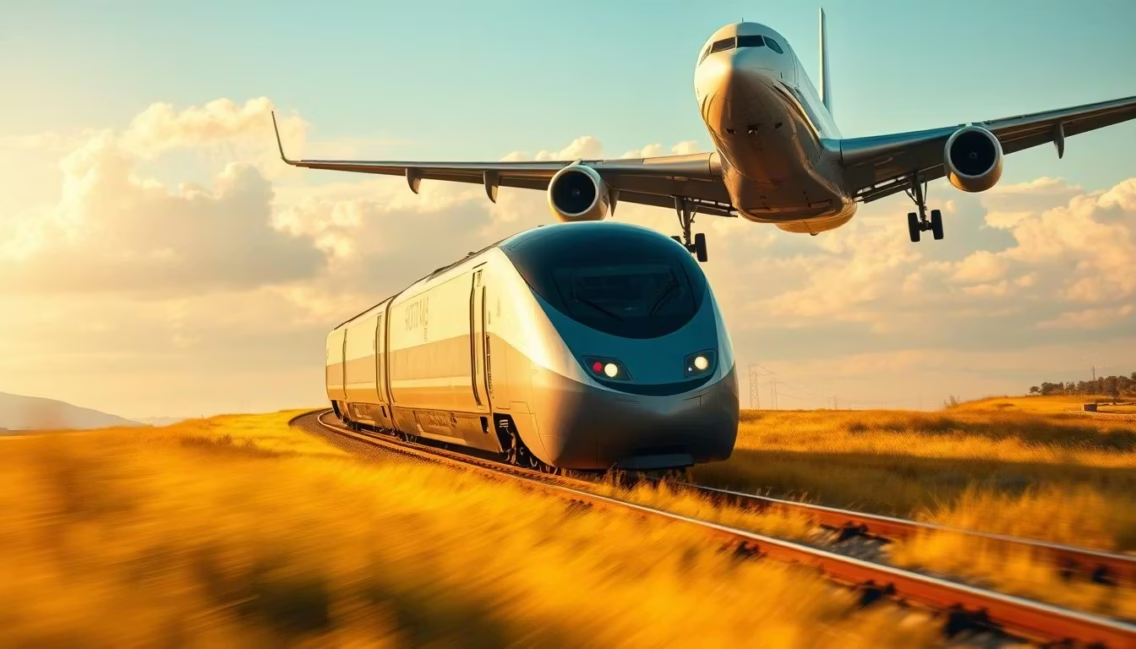
The New Luxury Is Slow Movement Across Borders
The new luxury is not speed. It is movement without friction.
The global travel conversation has quietly shifted, and at the center of it sits a question travelers once dismissed as impractical: rail vs flight.
For years, flying symbolized progress. Faster meant better. Shorter meant smarter. We optimized itineraries down to the minute, accepted stress as inevitable, and treated exhaustion as a fair trade for efficiency. Airports became the price of ambition. Airlines became experts at monetizing inconvenience.
Then travelers began to pause. Not because planes stopped working, but because the experience around them did. Delays stacked. Fees multiplied. Bodies compressed. Time fractured. What looked fast on paper increasingly felt expensive in practice—both financially and emotionally.
At the same time, trains were changing. Rail networks expanded. Borders softened. Sleeper cabins returned. High-speed corridors stitched cities together without the emotional tax of airports. Rail stopped being the slower option and started becoming the smarter one.
Today, rail vs flight is no longer a niche debate among environmentalists or travel purists. It is a mainstream reconsideration driven by three forces travelers understand instinctively: cost transparency, carbon impact, and comfort. This is a piece about why travelers across continents are stepping off planes and onto rails, and what changes when the journey itself becomes part of the destination.
By the end of this piece, you will not just understand the trend. You will feel why it is happening, and why it may change the way you move across borders next.
The Turning Point: When Speed Stopped Being the Goal
For decades, we measured progress by the clock. The faster the route, the smarter the traveler. But in 2025, that logic is unraveling. We are realizing that “fast” on paper often feels “expensive” in practice—logistically, physically, and emotionally.
Why Travelers Are Questioning Flights
On paper, flights promise speed. In reality, a two-hour flight routinely expands into a six-hour ordeal once you factor in airport transfers, security queues, and boarding delays. Travelers are no longer comparing departure times; they are comparing total effort. Trains depart from city centers, boarding takes minutes, and your luggage stays with you. Flying now feels optimized for airlines; rail feels optimized for people.
The Shift: From “Hustle” to Human Scale
This shift is why we are trading the “dead time” of airport security for the “living time” of the tracks. When you move by rail, the journey remains legible. Instead of being suspended in a sterile cabin, your nervous system stays regulated as landscapes transition gradually.
By choosing rail, travelers are reclaiming the middle of the story—arriving calmer, more connected, and ready to explore. You aren’t just being transported; you are moving at a pace that actually makes sense for the human body.
Rail vs Flight on Cost: The Numbers Travelers Are Finally Comparing
Cost has always shaped travel decisions, but travelers are now calculating it differently. Instead of asking which ticket looks cheaper, they are asking which journey actually costs less once everything is counted.
This is where rail vs flight comparisons start to favor trains.
Ticket Prices vs Total Trip Cost
Airfare often appears competitive at first glance. A low base fare creates the illusion of savings. The problem is that the ticket rarely reflects the true cost of flying.
Flights separate essentials into add-ons. Checked luggage, seat selection, meals, and even carry-on allowances now inflate prices incrementally. Each fee feels small in isolation, but together they erase the headline bargain. Train tickets, by contrast, tend to be honest. One price usually includes luggage, seating, and basic comfort. Travelers know what they are paying before they board.
When costs are compared door to door—home to destination—rail frequently undercuts air travel on short- and mid-haul routes.
Hidden Costs of Flying Most People Ignore
Beyond fees, flying imposes indirect costs that travelers rarely budget for but always feel.
Airports sit far from city centers, adding transport expenses and time. Delays disrupt hotel bookings, work schedules, and onward connections. Missed flights create cascading costs that extend well beyond the ticket price. There is also the cost of recovery. Fatigue shortens trips. Jet lag reduces productivity. A day lost to exhaustion is a cost, even if it never appears on a receipt.
Rail travel absorbs disruption differently. Delays remain contained. You stay mobile, seated, and oriented. Time feels less wasted because you are still traveling, not waiting.
Why Trains Win for Short- and Mid-Haul Routes
On routes under roughly 800 kilometers, trains often dominate the rail vs flight equation.
Travelers increasingly choose rail on corridors such as:
- Paris to Milan
- Berlin to Prague
- Tokyo to Kyoto
- Nairobi to Mombasa
These routes illustrate a broader pattern. When stations sit inside cities and schedules remain frequent, trains deliver efficiency without fragmentation. The cost advantage is not just financial. It is experiential. Travelers spend less time navigating systems and more time actually moving.
In an era where time feels increasingly scarce, that difference matters.
Carbon Impact: Why Rail Travel Is Becoming a Climate Statement
The environmental case for trains is no longer abstract, and travelers are no longer ignoring it. Climate awareness has moved from theory into daily decision-making, including how people choose to cross borders.
In the rail vs flight conversation, carbon impact has become a deciding factor rather than a footnote.
Rail vs Flight Emissions Explained Simply
Planes burn large amounts of fuel to lift weight into the air. Trains move efficiently along fixed tracks, often powered by electricity. The result is a significant emissions gap.
On average, rail travel produces up to 90 percent fewer carbon emissions per passenger-kilometer than flying. On electrified networks, especially those powered by renewables, that figure improves even further.
For travelers trying to reduce their footprint without giving up mobility, the choice becomes clear. One ticket carries a dramatically different environmental cost depending on the mode of transport.
Rail vs Truck Fuel Efficiency and Why It Matters
Rail efficiency extends beyond passenger travel. Compared to road transport, trains move far more people and goods using far less energy.
A single train can replace dozens of trucks, reducing fuel consumption, traffic congestion, and air pollution. This efficiency lowers the overall environmental burden of transport systems, not just individual journeys. When travelers choose trains, they support infrastructure that scales sustainability rather than undermining it.
Why Eco-Conscious Travelers Are Voting With Tickets
For many travelers, rail has become a quiet statement. It signals an understanding that movement has consequences and that convenience should not always come at the planet’s expense.
This shift is not driven by guilt. It is driven by alignment. Travelers want their choices to reflect their values without sacrificing comfort or access. Rail travel offers that balance. It allows people to move freely while participating in a more responsible system.
As climate conversations become more practical and less theoretical, trains fit naturally into the future that travelers want to build.
Comfort Has Entered the Chat
Comfort used to rank low in travel decisions. Speed overshadowed everything. If a journey arrived quickly, discomfort felt acceptable. That hierarchy has changed. As travelers reassess rail vs flight, comfort has moved from a luxury consideration to a core requirement.
Space, Movement, and Mental Health
Air travel compresses the body. Seats limit movement. Aisles narrow. The cabin environment encourages stillness, even when the body resists it. Trains offer the opposite. Passengers stand, stretch, walk, and reposition without friction. Seats provide legroom by design, not as a paid upgrade. Windows stay large and unobstructed.
This freedom affects more than posture. It regulates stress. Movement reduces fatigue. The journey becomes physically manageable rather than something to endure. Travelers increasingly recognize that comfort is not indulgence. It is functional.
Why Train Time Feels Like Living, Not Waiting
Flying places travelers in holding patterns. Airports, gates, boarding queues, and tarmacs all exist outside normal time. You wait without moving. Train travel collapses that distinction. Once aboard, the journey begins. Time feels usable rather than suspended.
People read, write, work, sleep, eat, and watch the world change. Even when the train slows, progress continues. The sensation of stagnation disappears. This is why train journeys feel shorter than their duration suggests. Engagement replaces anticipation.
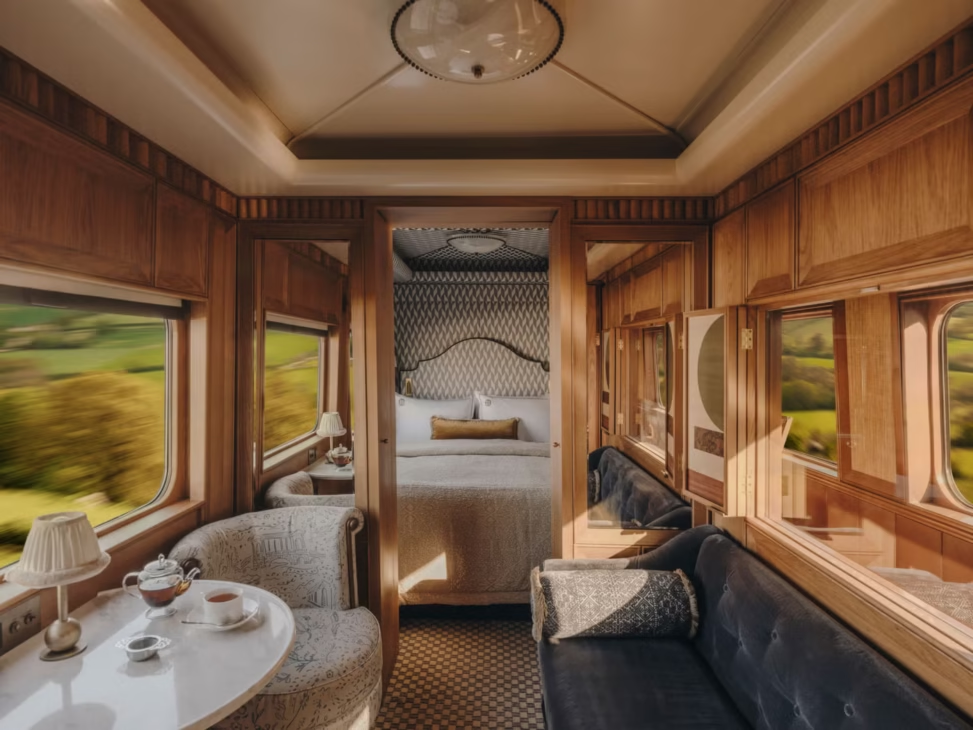
Food, Views, and Sleep: The Overlooked Luxuries
Meals on trains arrive with intention rather than efficiency. They are served hot, often regional, and eaten without rush. Sleeper cabins allow real rest instead of fitful dozing. Views matter too. Landscapes unfold continuously, turning the journey into an experience rather than a transition.
In the rail vs flight comparison, comfort is no longer subjective. It is structural. Trains are built for human rhythms. Planes are built for throughput. That difference defines how travelers feel when they arrive.
Story Time: Crossing East Africa Without Flying
My understanding of rail vs flight stopped being theoretical the moment I chose not to board a plane. Instead of flying across East Africa, I moved through it.
Kenya to Tanzania by Rail and Road
The decision started simply. I wanted to see the space between destinations, not just the destinations themselves. So I took the slower route—part rail, part road—moving from Kenya toward Tanzania. The journey did not compress into hours. It stretched into days. Cities softened into towns. Towns gave way to open land. The pace forced attention.
On trains and buses, time behaved differently. Conversations replaced announcements. Vendors moved through aisles. Landscapes did not blur; they introduced themselves gradually.
Borders, Conversations, and the Human Scale of Travel
Crossing borders without flying changes their meaning. There were no sealed corridors or sterile arrival halls. Instead, borders felt like thresholds. People waited together. Questions were asked and answered face-to-face. Movement felt collective rather than individualized.
I spoke with traders, students, families, and solo travelers. Everyone had a reason for moving, and the journey made those reasons visible. This is something flights cannot offer. Air travel erases the middle. It removes context.
What Flying Would Have Erased From the Experience
Had I flown, I would have arrived faster. I would have missed almost everything else. The gradual shift in language. The change in architecture. The way the land opened and closed. The feeling of continuity between places that maps often separate too sharply.
Rail and overland travel preserved the story of the journey. It allowed movement to remain legible. That experience clarified why travelers are returning to trains. Rail does not just transport people. It keeps them present. And once you experience travel without erasure, flying starts to feel like skipping chapters you did not know you needed.
Safety Myths: Are Planes Safer Than Trains?
Safety often enters the rail vs flight conversation late, but when it does, it tends to dominate. Many travelers assume flying is inherently safer because it feels more controlled, more regulated, and more technologically advanced.
The data tells a more balanced story.
Is Train Safer Than Plane? The Data Explained
Both trains and planes rank among the safest forms of transport in the world. Serious incidents are rare in either case. However, when safety is measured per passenger-kilometer traveled, rail often performs as well as, and in some regions better than, air travel.
Train systems benefit from fixed infrastructure, automated controls, and fewer variables during operation. There is no congestion at altitude, no weather-related rerouting midair, and fewer points of catastrophic failure. This does not make flying unsafe. It makes trains comparably reliable.
Why Perceived Risk Skews the Rail vs Flight Debate
Public perception of safety rarely aligns with probability.
Plane incidents dominate global headlines because they are dramatic and highly visible. Train incidents, which are often localized and less spectacular, receive far less attention. As a result, travelers tend to overestimate the risks of rail travel while underestimating the cumulative risks associated with frequent flying, such as fatigue-related errors and operational complexity.
In reality, safety differences between trains and planes are marginal compared to how safe both modes already are. The choice between them should rest on experience, efficiency, and impact—not fear. When travelers move past perception and toward data, rail earns its place as a trustworthy option.

Global Snapshot: Top 2025 Rail Corridors
While infrastructure varies by continent, the most successful routes in 2025 have one thing in common: they compete directly with air travel on door-to-door efficiency.
| Region | Trending Route | Why Travelers Choose It |
| Europe | Paris ↔ Barcelona | Replaces two airport transfers with city-center hubs; high-speed and scenic. |
| Asia | Beijing ↔ Shanghai | A new 2025 high-speed link will cut travel time to under 2 hours. |
| Africa | Nairobi ↔ Mombasa | Modernizes domestic travel with a safe, efficient alternative to road and air. |
| Middle East | Riyadh ↔ Doha | New “Borealis” services are proving that mid-haul rail is regaining its footing. |
| N. America | Chicago ↔ St. Paul | New “Borealis” services proving that mid-haul rail is regaining its footing. |
The “Success Formula” for 2025 Rail
Across these regions, the trend is no longer about rejecting planes; it’s about selecting the mode that respects the traveler’s time and environment.
- Interoperability: New EU rules in 2025 are making cross-border driver certification easier, smoothing out transitions between countries.
- The 800km Rule: On routes under 800 kilometers, rail is becoming the default choice due to the “hidden time” of airport security.
- Luxury as Sleep: The return of the night train (like the European Sleeper or La Dolce Vita) allows travelers to treat transport time as hotel time.
The New Travel Status Symbol
Travel has always reflected status, but the markers are changing. Where speed once signaled importance, intention now carries more weight. In the evolving rail vs flight narrative, trains have become a quiet symbol of control.
From Hustle Culture to Intentional Movement
For years, travel mirrored hustle culture. Faster schedules implied productivity. Tight connections suggested ambition. Rest was something to earn later. That logic is losing influence.
Travelers now value journeys that integrate into life rather than interrupt it. Choosing rail often means choosing fewer disruptions, better sleep, and the ability to remain present while moving. This shift reflects a broader cultural recalibration. Time is no longer something to compress at all costs. It is something to manage well.
Why Slow Travel Signals Privilege, Not Inconvenience
Slow travel does not mean inefficient travel. It signals choice. The ability to move at a measured pace suggests autonomy. It implies flexibility in schedules and confidence in arrival. Travelers who choose trains are not opting out of progress. They are opting into agency.
In this sense, rail travel has become aspirational. It reflects a traveler who understands that true luxury is not speed, but ease. As the meaning of status evolves, trains increasingly align with how modern travelers want to be seen—and how they want to feel.
FAQs
Is Train Travel Really Cheaper Than Flying?
Often yes, but it depends on the route and timing. Trains are most cost-effective on short- and mid-haul journeys where stations are city-centered. When factoring in baggage, transport to airports, and hidden fees, trains frequently undercut flights.
Does Rail Take Too Long?
Trains are slower in raw minutes, but travelers often experience the journey as less exhausting. Onboard productivity, sleep, or leisure time offsets the longer duration. Time is used differently: you move while living, rather than waiting to move.
Is Train Travel Safe Across Borders?
Rail is extremely safe. Modern infrastructure, automated signaling, and lower traffic variables contribute to excellent safety records. Delays exist, but they rarely compromise security or physical safety. Compared to flying, the risk per passenger-kilometer is comparable.
Are Scenic Views and Comfort Really Worth the Extra Hours?
Yes. Comfort, movement, and scenery reduce travel fatigue, improve well-being, and enrich experiences. Many travelers find the qualitative benefits of train journeys outweigh a modest increase in travel time.
Can Rail Travel Replace Flights for Long Distances?
It depends on infrastructure. In regions with high-speed or overnight services, rail is often a viable substitute. In developing corridors, it may complement rather than replace flights, but the trend is toward expansion and improvement.
The Verdict: Rail vs Flight Is No Longer a Debate
Rail vs flight has evolved beyond efficiency. Trains win on cost clarity. They dominate carbon metrics. They redefine comfort. They humanize distance.
Travelers are not rejecting planes entirely. They are choosing trains intentionally. And once you experience movement without compression, without rush, without erasure, flying begins to feel outdated. The future of travel is not faster. It is fuller.
Join the Movement: If time and cost were equal, which city-to-city route would you choose to travel by train instead of flying?